How to Make a Room Cosy: Warmth, Light and Texture
Make any room feel cosy with layered warm lighting, soft textures, fuller curtains and seating pulled close together — eight practical steps.
The short answer: cosiness comes in layers
Cosiness isn't one thing you buy. It's a set of layers working together, and the order you do them in matters more than the budget.
If you want the short answer: warm the light, warm the floor, warm the surfaces, then pull the furniture in close. Do those four things and most rooms feel noticeably different within an afternoon.
A room that feels cold usually isn't short of furniture. It's lit by a single bright ceiling fitting in cool white, has hard flooring with nothing soft underfoot, has short curtains that stop at the window sill, and has every chair pushed back against a wall. Fix that combination and the room stops echoing around you and starts to hold you.
None of it requires decorating, new furniture or a big spend. Lighting, textiles and layout do most of the work, and all three are reversible if you rent or change your mind.
What you need before you start
You don't need to buy all of this at once — most people already own half of it and just have it in the wrong room. Gather what you have first, then fill the gaps.
- Warm white bulbs
- Around 2700K, dimmable where the fitting allows. The single most effective swap in the room.
- Rug
- Large enough for the front feet of the sofa and chairs to sit on, not a small mat in the middle of the floor.
- Curtains
- Roughly 1.5 to 2 times the pole width, lined, finishing at the floor or just below the sill.
- Textiles
- At least three different weaves — wool, linen, velvet, bouclé or chunky knit.
- Lamps
- Two or three table or floor lamps to supplement the ceiling light, not replace it entirely.
- Time
- An afternoon for lighting, textiles and layout; a weekend if you're also painting or fitting a new pole.
How to make a room cosy in 8 steps
1. Start with the floor
Cold floors undo everything else. On hard flooring, put down a thick rug — wool or a wool blend with a proper pile — and add an underlay beneath it if the floor is cold to stand on. On carpet, layer a smaller rug rather than trying to cover the whole floor; it adds softness and defines the seating area.
2. Switch to warm, low lighting
Replace cool bulbs with warm white ones around 2700K and turn the ceiling light off in the evening. Add at least two lamps at different heights — a floor lamp beside the sofa, a table lamp on a side table or shelf — so the room is lit in pools rather than flooded from above.
3. Pull the seating together
Move the sofa and chairs in from the walls and angle them towards each other. Aim for roughly 1.8 to 2.4 metres between facing seats: close enough to talk without raising your voice, far enough to walk through. A side table between two chairs does more for cosiness than another armchair in a corner.
4. Layer at least three textures
Cosy rooms are full of things you want to touch. Mix weaves rather than repeating one: a wool throw over the sofa back, a linen cushion, a velvet or bouclé cushion, a chunky knit in a basket. Vary the sizes too — larger cushions at the back, smaller ones in front.
5. Warm the colour palette
You don't need to repaint. Swap two cool-grey or brilliant-white cushion covers for clay, rust, ochre or deep green, change a cool white shade for a warm linen one, and add a warm-toned throw. If you are painting anyway, take one alcove or chimney breast a shade deeper and warmer than the walls.
6. Dress the windows properly
Hang the pole 15 to 20 centimetres beyond the window recess on each side and close to the ceiling. Use curtains with roughly 1.5 to 2 times the pole width so they fold properly, lined and floor-length. Add a blind behind them and the window stops being a cold black rectangle after dark.
7. Give the room a focal point
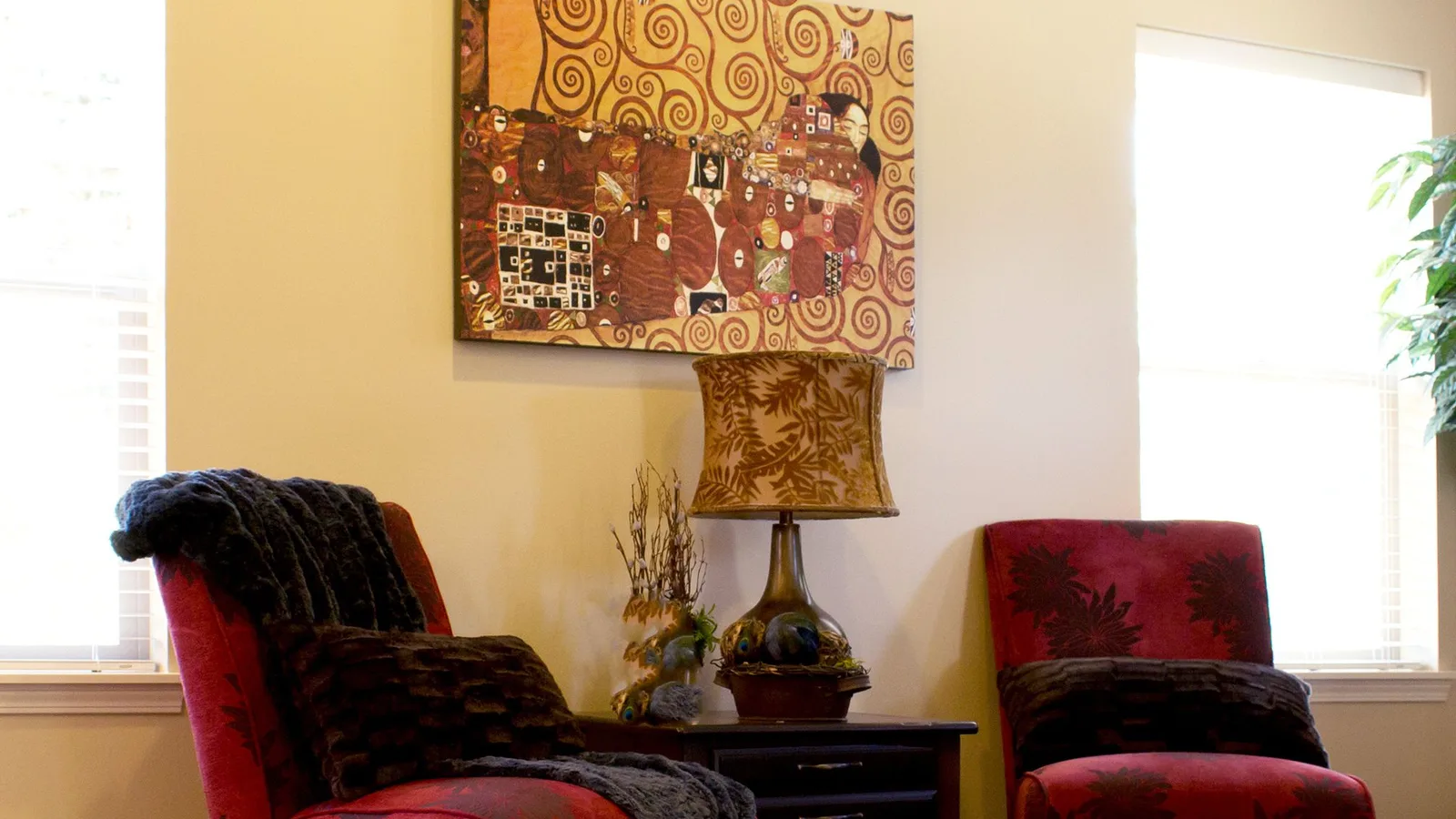
Every cosy room has somewhere for the eye to settle: a fireplace, a lamp-lit corner with a chair, a shelf of books, a large framed picture. Arrange the seating to face it rather than pointing at a television or a blank wall.
8. Finish with scent and sound
One scent, not four — a single candle or a diffuser, placed where you sit rather than by the door. Soft furnishings also absorb sound, so a room with a rug, curtains and cushions naturally loses its echo. If you want music, keep it low enough to talk over.
Lighting: the change that does the most work
A single pendant in the middle of the ceiling lights a room evenly, and that's exactly the problem. Even, bright overhead light flattens everything and leaves no shadows to soften the edges of the room.
Aim for three or more sources at different heights: a ceiling light you rarely use, a floor lamp, a table lamp, a small lamp on a shelf. Each casts its own pool of light, and the dimmer spaces between them are what make a room feel restful.
Colour temperature matters as much as brightness. Warm white bulbs around 2700K give the amber glow most people mean by cosy; 3000K is cleaner and slightly cooler; anything at 4000K and above reads as office-like. Check the number on the box rather than the name — "warm white" is used loosely by retailers.
Shades matter too. A bare bulb or a clear glass shade glares; fabric, paper or opal glass diffuses the light. If your ceiling fitting is the only light in the room, one lamp on a dimmable plug will change the whole feel of an evening.
Texture and softness: build in threes
The quickest test of a cold room is to look for flat surfaces. Bare floor, bare sofa, bare windowsill, plain walls — nothing catches the light or invites you to sit down.
Work in threes, mixing rather than matching:
- A wool or wool-blend throw over the arm of the sofa and another over a chair
- Cushions in mixed weaves and sizes, in odd numbers rather than symmetrical pairs
- A linen or cotton cushion to break up heavier wool and velvet
- A chunky knit blanket kept in a basket within reach
- A rug with a pile rather than a flatweave
- Something soft at the window: a linen blind, a heavier curtain, a seat pad on a window seat
Texture changes sound as well as looks. Soft surfaces absorb echo, which is why a furnished room sounds calmer than an empty one — and why adding a rug and curtains can make a room feel warmer before the heating has done anything at all.
Colour that warms a room without decorating
Cool greys, brilliant white and blue-toned light all push a room towards clinical, and most of us have at least one of the three. Warm colours advance towards you and absorb light; cool colours recede and reflect it.
Start with the things you can change in an hour:
- Cushions and throws. Two clay, rust, ochre or deep-green covers will do more than a whole new colour scheme.
- Lampshades. A warm off-white linen or paper shade instead of a grey, black or cool white one changes the colour of the light itself.
- Bulbs. A cooler bulb will make even a warm scheme look grey.
- The walls you actually see. A large framed print or a wall hanging breaks up a flat expanse without a paintbrush.
- Wood and brass. Warm metals and natural wood next to glass and chrome soften a room considerably.
If you are painting, keep ceilings lighter than the walls; a ceiling darker than the room reads as low and heavy.
Windows and draughts: warmth you can actually feel
Windows are where a room loses most of its heat and where a cold room is most obviously cold. Curtains hung on a pole barely wider than the window, stopping at the sill, do very little — air simply falls behind them.
Go wider, longer and fuller:
- Extend the pole 15 to 20 centimetres past the recess on each side so the curtains stack clear of the glass
- Choose fabric around 1.5 to 2 times the pole width so it hangs in folds
- Line them, ideally with a thermal or blackout lining
- Take them to the floor, or just below the sill if a radiator sits underneath
- Hang the pole high, close to the ceiling, to make the window feel larger
- Layer a blind behind the curtains for evenings
For draughts, a fabric excluder at the bottom of a door and brush strips around a letterbox make a real difference at ankle height. Don't block air bricks, trickle vents or vents serving a gas fire or wood burner — those need to stay open.
Layout: pull everything in closer
Rooms feel cold when the furniture is arranged like a waiting room: everything flat against the walls, a wide empty middle, nothing within arm's reach. Cosy rooms are arranged around a conversation or a fire, with a rug underneath to hold the group together.
Floating a sofa a little way into the room, even by 30 or 40 centimetres, immediately changes how the space feels. Add a slim console behind it if the gap feels odd. What you're after is somewhere to put a cup down without getting up.
What separates a room that feels cosy from one that feels cold and formal
Element
Cosy
- Lighting
- Three or more low, warm sources, each on its own switch
- Seating
- Pulled in close and angled towards each other
- Floor
- Thick rug under the front feet of the sofa
- Curtains
- Full, lined and floor-length, hung high
- Colour
- Warm neutrals, clay, rust, deep green
- Texture
- Several weaves mixed: wool, linen, velvet, bouclé
Cold and formal
- Lighting
- One bright ceiling fitting in cool white
- Seating
- Pushed back flat against the walls
- Floor
- Bare boards or a thin runner beside the sofa
- Curtains
- Short, unlined and just covering the glass
- Colour
- Cool greys, brilliant white, blue-toned light
- Texture
- One flat fabric repeated across the room
Common mistakes and how to fix them
- Relying on the big light. It's the most common reason a well-furnished room still feels bleak. Fix: lamps on a plug or switch, and use the ceiling light only when you need to see properly.
- A rug that's too small. A small rug in the middle of the floor makes the room look smaller and colder. Fix: at least the front feet of the sofa and chairs should sit on it.
- Too much fragrance. Three candles in one room cancel each other out and can give you a headache. Fix: one scent, placed near where you sit.
- Buying a matching set. Sets of cushions, throws and rugs in the same fabric look like a showroom. Fix: mix weaves, sizes and slightly different tones.
- Cluttering instead of layering. Cosy isn't the same as full. Fix: keep a clear walkway and clear surfaces beside the seats.
- Ignoring the glare. A lamp without a shade, or one at eye level opposite the sofa, is uncomfortable rather than cosy. Fix: shades that diffuse, and lamps below seated eye level.
Safety: candles, heaters and textiles
Cosy rooms are full of things that burn or get hot next to things that burn easily, so a few habits are worth keeping.
Small rooms and rented rooms
You can do nearly all of this without touching the walls or losing a deposit.
- Use tension rods inside a window recess if you can't drill for a pole
- Choose one floor lamp rather than a large pendant, so nothing is wired in
- Layer a rug over existing carpet rather than replacing it
- Lean a large framed picture or mirror against the wall instead of hanging it — a mirror also bounces lamplight into a dark corner
- Choose two or three larger pieces over lots of small ones; small furniture in a small room makes it look busier, not bigger
- Keep the ceiling light off and use lamps on plug-in dimmers
In a genuinely tiny room, pick one wall to warm up with a textile or a deep colour and leave the rest light, rather than warming everything at once.
Common questions about making a room cosy
What colour makes a room feel cosy?
How many lamps does a cosy living room need?
Does a rug really make a room feel warmer?
Can I make a rented room cosy without decorating?
What colour temperature should cosy lighting be?
Related articles

How to choose a couch: 6 steps to a sofa you'll keep
Measure the room and the route in, test the seat properly and check the frame before you buy — a practical UK guide to choosing a couch.
Step-by-Step Guides
How to clean a barbecue: a spotless result in 7 steps
A simple step-by-step guide to cleaning your barbecue safely, from degreasing the grates to protecting the burners and stopping rust.
Step-by-Step Guides
How to clean a rug: 6 steps to a fresher, softer floor
A practical UK guide to cleaning rugs at home: how to vacuum, spot-clean and wash wool, synthetic and natural-fibre rugs, then dry them without damage.
Step-by-Step Guides
How to clean an air fryer: a 6-step routine that works
A step-by-step guide to cleaning an air fryer: how to wash the basket, tackle the heating element and avoid the mistakes that ruin the coating.
Step-by-Step Guides
How to clean garden furniture: 6 steps to a fresh set
A practical, material-by-material guide to cleaning garden furniture: the soapy-water method, shifting green algae, and the mistakes to avoid.
Step-by-Step Guides
How to Hang Curtains: Straight, Even Folds Every Time
Measure, fit the pole and hang curtains so they fall straight and even, plus fixes for dragging hems, gaps at the edges and stubborn folds.
Step-by-Step Guides
How to measure for a sofa: get the fit right first time
Measure your room, your delivery route and the sofa itself before you buy. A practical UK guide to getting sofa dimensions and clearances right.
Step-by-Step Guides
How to remove scratches from wood furniture in 5 steps
Most scratches sit in the finish, not the wood. A practical, step-by-step guide to wax filling, blending and refinishing marks on UK furniture.
Step-by-Step Guides
How to season a cast iron pan: 5 steps to a non-stick finish
Season a cast iron pan properly: how to clean it, which oil to use, oven temperature, the five steps and how to fix a sticky or flaking finish.
Step-by-Step Guides